

There is a reason people have kept amethyst in their homes for centuries. Not just for its beauty, though that alone is reason enough, but for what it brings to a space: a quality of stillness, of weight, of something that feels permanent in a world that rarely does.
If you've recently added an amethyst cluster or geode to your collection, or you're considering one, the question of where to place it matters more than most people think. The right position amplifies everything the stone already offers. The wrong one wastes it.
This guide walks through the best placements, room by room, based on how natural amethyst interacts with light, space, and the people who live alongside it.
What makes amethyst different as a home object
Before getting into placement, it helps to understand what sets a natural amethyst cluster apart from decorative objects that simply sit on a shelf.
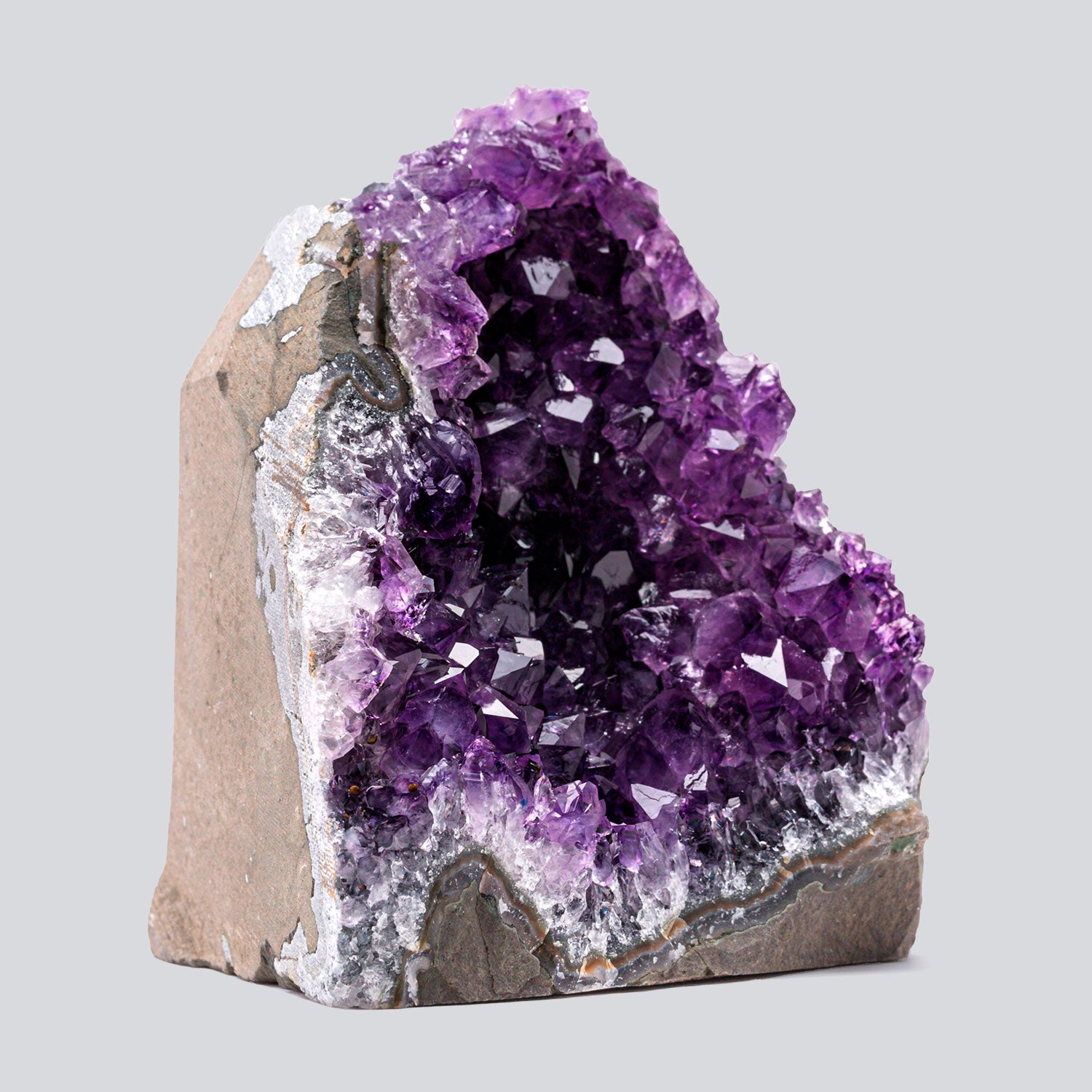
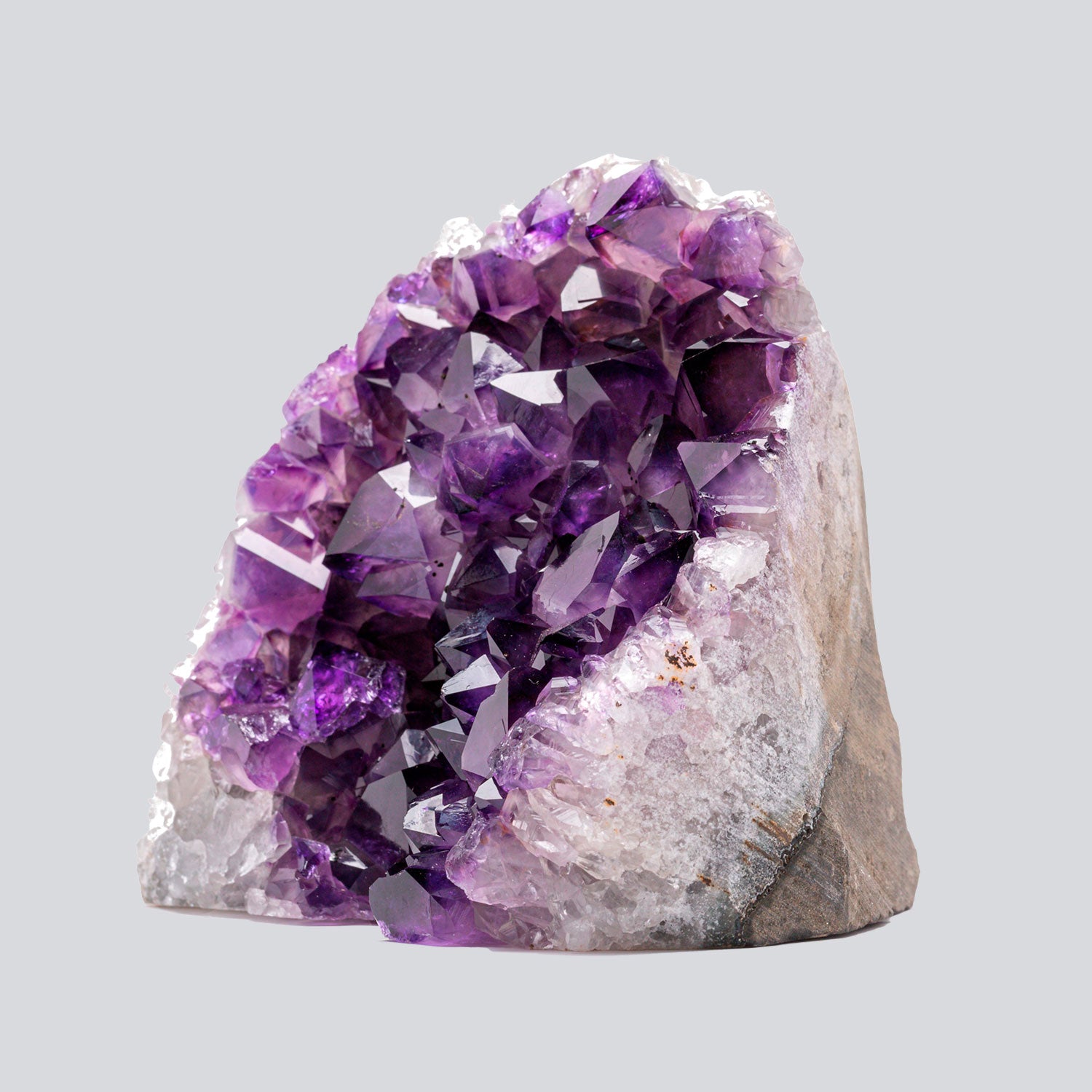
Amethyst is a form of quartz. Its purple color comes from trace amounts of iron and natural irradiation during formation, a process that takes millions of years inside volcanic rock cavities. The crystals you see on the surface of a cluster or geode are the result of that slow, pressurized growth.
This matters for placement because natural amethyst is responsive to light. Unlike painted or dyed decor, the crystal structure of amethyst refracts and reflects light differently depending on the angle, the time of day, and the quality of the light source. A piece placed near a west-facing window at 4pm will look completely different than the same piece under a warm lamp at night.
That responsiveness is what makes placement a creative decision, not just a logistical one.
The living room: amethyst as a statement anchor
The living room is where most people place their first large amethyst piece, and for good reason. It's the space where guests gather, where the eye naturally looks for focal points, and where a substantial object can earn its presence without feeling out of place.
Best positions in the living room:
A large amethyst cluster or geode works best when it has room to breathe. Place it on a low surface, a coffee table, a media console, a low bookshelf, rather than up high. The crystal faces should be at or slightly below eye level when seated. This allows the light to catch the facets naturally as it moves through the room throughout the day.
Avoid placing amethyst directly in front of a window where strong backlight will flatten its color. Instead, position it to the side of a light source, where the light skims across the crystal surface and brings out the depth of the purple.
If you have a fireplace, the mantel can work beautifully, but only if the piece is large enough to hold its own in that vertical space. A small cluster on a wide mantel will look lost. A substantial geode, on the other hand, becomes the natural center of gravity for the entire room.
What to pair it with:
Amethyst reads as a luxury material when placed near other natural textures: raw wood, linen, matte ceramics, aged brass. It reads as decorative when placed near synthetic or highly polished surfaces. Let the stone be the most interesting object in its immediate area, and keep the surrounding palette neutral.
The home office: presence without distraction
There's a growing conversation around how the objects in a workspace affect focus, creativity, and the quality of thinking that happens there. Amethyst fits naturally into this conversation, not because of any metaphysical claim, but because of something more observable: a beautiful, weighty object gives the eye somewhere to rest.
In a workspace dominated by screens, notifications, and constant input, having a physical object of quality nearby creates a natural counterpoint. The eye drifts to it, rests for a moment, and returns to work. This is the same reason serious writers and thinkers have always surrounded themselves with objects of substance.
Best positions in the home office:
The most effective placement is within your natural sightline, but not directly between you and your screen. A corner of the desk, or a dedicated shelf at desk height, works well. You want the piece visible without being in the way.
For smaller workspaces, a hand-sized cluster on the desk itself is ideal, substantial enough to have presence, compact enough not to crowd the surface. For larger offices or studios, a shelf-sized piece at eye level when standing creates a natural anchor for the whole room.
Light considerations for the office:
If your office has natural light, position the amethyst where it will catch morning or afternoon light rather than harsh midday sun. The warm light of early morning or late afternoon brings out the warmest tones in the purple and makes the crystal surfaces glow rather than glare.
Under artificial light, amethyst responds well to warm-toned bulbs in the range of 2700K to 3000K. Cool white or blue-toned light tends to flatten the color and reduce the visual depth of the crystal.
The bedroom: the case for restraint
Amethyst in the bedroom is common advice, and the reasoning is straightforward: the color itself, that particular purple, neither warm nor cold, has a quality that most people find calming rather than stimulating.
But restraint matters here. The bedroom is not a gallery. One piece, well-placed, is better than several competing for attention.
Best positions in the bedroom:
A medium-sized cluster on a nightstand or dresser is the classic placement, and it works because it's the first thing you see when you wake and the last when you sleep. If you choose this, keep the nightstand otherwise clear. The amethyst should be the single decorative object in that immediate space.
An alternative that's less common but highly effective: a substantial piece on a low surface at the foot of the bed, where it anchors the room visually without being immediately adjacent to sleep. This works especially well for larger clusters or geodes that might feel too dominant on a small nightstand.
What to avoid in the bedroom:
Avoid placing amethyst directly on the floor unless it's a very large piece. A substantial geode on the floor in a corner can work beautifully. Small pieces at floor level tend to disappear.
Also avoid cluttering the area around it. Amethyst in the bedroom earns its place through singular presence, not through being part of a collection of objects.
The entryway: the first impression
The entry of a home sets the tone for everything that follows. It's the transition zone between outside and inside, between the world's pace and your own. An amethyst piece here functions as a signal: this is a home where beauty and intention coexist.
Best positions in the entryway:
A console table or entry shelf is the natural surface. The piece should be substantial enough to register immediately. A small cluster in an entryway tends to get overlooked. A shelf-sized or larger piece, positioned at chest height, stops the eye naturally as you walk in.
If the entryway has natural light from a window or glass door, the amethyst will catch and refract that light in a way that changes throughout the day. This kind of dynamic quality, a piece that looks different in morning light versus evening, rewards repeated attention.
The summer solstice and the quality of light
There is something worth noting about placing amethyst in your home around the summer solstice, the longest day of the year, when light arrives early, stays late, and comes in at a lower angle than at other times of year.
That low-angle summer light is particularly beautiful on crystal surfaces. It creates longer shadows, stronger contrast between the lit and unlit facets, and a warmth to the purple that midday overhead light doesn't produce.
If you're placing a new piece in your home this season, spend a few days observing where the summer light moves through your space before committing to a permanent position. The piece that looks best in June may reward patience, placed where the light actually falls, rather than where convention suggests.
Choosing the right size for your space
One of the most common mistakes in placing amethyst is choosing a piece that's too small for the surface or room. Natural amethyst clusters and geodes have presence, they're objects of weight and substance, but that presence requires appropriate scale to register.
A rough guide:
Hand-sized clusters (1 to 2 lb) work well on desks, nightstands, bathroom counters, and smaller shelves. They're intimate objects, best appreciated up close.
Shelf-sized clusters (2 to 5 lb) are the most versatile. They work on bookshelves, console tables, coffee tables, and bedroom dressers. Large enough to anchor a surface, compact enough to work in most rooms.
Large clusters (5 to 10 lb) belong on wider surfaces where they have room to command attention: an entry console, a living room coffee table, a dedicated shelf in a studio or office. These pieces stop the eye from across the room.
XL unique specimens (10 lb and above) are in a category of their own. Each one is a singular object, unrepeatable in form and character. They need space to be seen: a low surface with nothing competing nearby, a floor placement in a corner with good light, or a dedicated surface where the piece is the sole focal point. These are not decorative objects. They are the room.
A note on origin and what it adds to the object
Not all amethyst is equal, and the source matters, not just for quality, but for the story the object carries.
The amethyst at Emporion Gems is sourced directly from Artigas, Uruguay, a region whose geological conditions produce some of the deepest, most saturated purple amethyst found anywhere in the world. Each piece comes with a Certificate of Origin and a unique serial number, a chain of custody that connects the object in your home to the specific mine and region where it formed.
For a piece you're placing permanently in your home, that traceability adds a layer of meaning that purely decorative objects don't have. You're not just placing a beautiful stone. You're placing a specific, unrepeatable object with a documented history.
Find the right piece for your space
Whether you're looking for a hand-sized cluster for your desk, a shelf piece for the living room, or a substantial geode to anchor a larger space, the Emporion Gems collection offers natural AAA grade amethyst sourced directly from Artigas, Uruguay. Each piece is photographed individually, with its weight and serial number documented.
All Emporion Gems amethyst is ethically sourced from Artigas, Uruguay, and comes with a Certificate of Origin. Free shipping on all US orders.






Share: