

Not all amethyst is priced equally, and color is the first reason why.
When buyers compare two amethyst clusters side by side, the deeper, darker purple almost always commands a higher price. That's not arbitrary. It reflects real geological rarity, formation conditions, and grading standards that the crystal market has recognized for decades.
This guide breaks down exactly what makes a deep purple amethyst more valuable — and what to look for when you're buying.
Color Saturation Is the Primary Value Driver
In the amethyst market, color is the single most important quality factor. The deeper and more saturated the purple, the higher the value, full stop.
The color scale runs from pale lavender (common, lower value) through medium violet to deep, rich purple and finally to the prized dark purple amethyst with wine-red or blue-violet undertones. The deepest saturations are the rarest and the most sought after by collectors and interior designers.
What creates that depth? Iron. Amethyst gets its purple color from iron impurities within quartz, activated by natural irradiation during formation. Higher iron concentrations and specific irradiation conditions produce deeper color. These conditions are not uniformly distributed across all deposits — which is why origin matters so much.
Why Uruguayan Amethyst Produces the Deepest Purple
The world's finest deep purple amethyst clusters come predominantly from Uruguay — specifically from the Artigas region in the country's north.
Uruguayan deposits form in smaller, more concentrated volcanic pockets. The slower, more constrained crystal growth combined with higher iron content produces the saturated, almost velvety purple that defines collector-grade amethyst. The color is consistent through the crystal, not just at the surface.
Brazilian amethyst, by contrast, forms in larger volcanic cavities with faster growth rates. The result is beautiful, but lighter. Pale lavender and medium violet are the norm, not the exception.
When you see a deep purple amethyst cluster with that unmistakable dark, rich color, it is almost certainly Uruguayan. That origin is a quality signal, not just a geographic label.
What Is AAA Grade Amethyst?
AAA grade amethyst is the highest quality classification in the crystal trade. It indicates a specimen that meets strict standards across multiple criteria simultaneously:
- Color: Deep, saturated purple, no pale zones, no color banding visible from the front
- Clarity: Minimal inclusions, no cracks or fractures that compromise structural integrity
- Formation: Well-defined crystal points with natural terminations intact
- Surface: High natural luster, no significant chips or damage
- Origin: Typically Uruguayan, given the color requirements
AAA grade pieces represent a small fraction of total amethyst production. Most amethyst mined globally falls into A or AB grade, usable and attractive, but not collector quality.
The grade directly affects price. An AAA grade amethyst cluster of the same size as an A grade piece can command two to four times the price — sometimes more for exceptional specimens.
Formation Type: Why Clusters Matter
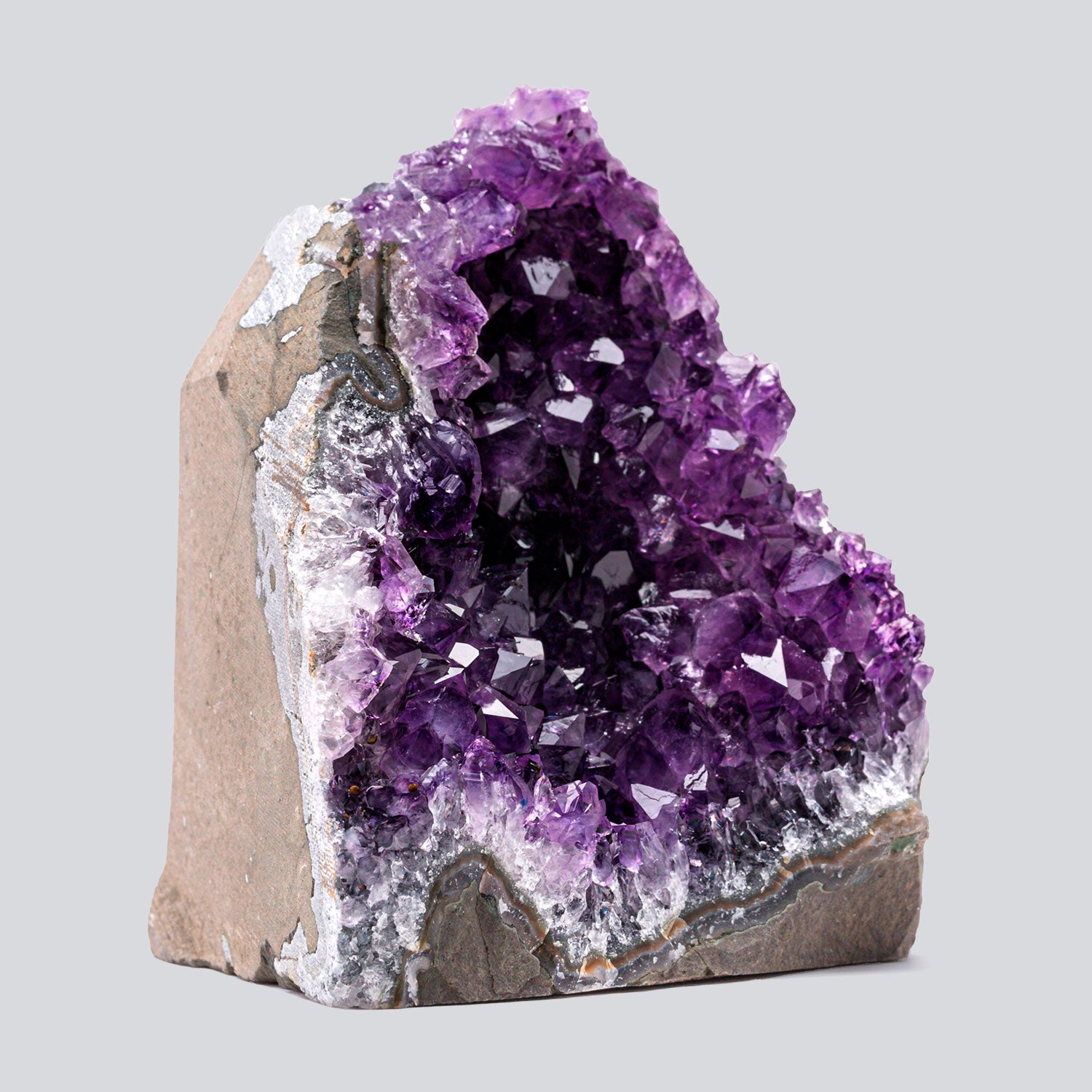
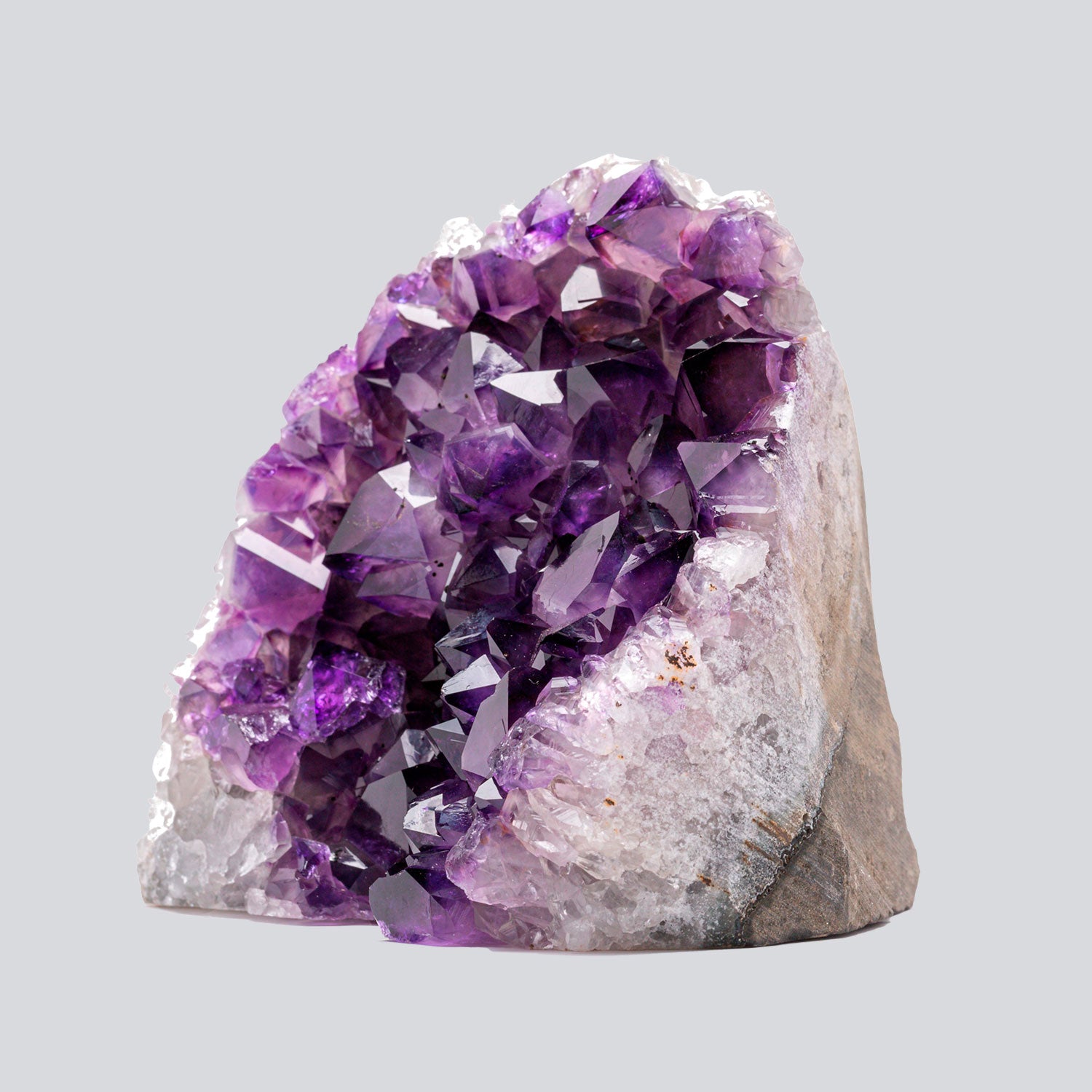
A deep purple amethyst cluster, multiple crystal points growing from a shared matrix base — is one of the most desirable formations for both collectors and interior use.
Clusters display color from multiple angles simultaneously. The faceted surfaces of each crystal point catch and refract light differently, creating a dynamic visual effect that single points or tumbled stones cannot replicate. In deep purple specimens, this effect is particularly striking: the color shifts between violet, indigo, and burgundy depending on the light source and viewing angle.
The matrix base also matters. A thick, stable base with good mineral contrast — often grey or brown basalt in Uruguayan pieces, frames the crystals and adds to the overall visual weight of the piece.
Size, Weight, and the Rarity Premium
Deep purple color becomes exponentially rarer at larger sizes.
Small clusters (under 1 lb) with good color saturation are relatively accessible. Medium clusters (1–5 lbs) with AAA-grade deep purple are significantly rarer and priced accordingly. Large clusters and amethyst geodes above 10 lbs with consistent deep purple throughout are genuinely scarce — these are the pieces that collectors and designers compete for.
This is why deep purple amethyst value doesn't scale linearly with size. A 5 lb deep purple cluster is not simply five times the price of a 1 lb piece — it may be ten to twenty times the price, because maintaining that color saturation at scale is rare.
How to Evaluate Deep Purple Amethyst Before Buying
When assessing a piece, look for:
- Color consistency: Deep purple should be present throughout the visible crystals, not just at the tips
- Undertone quality: The best specimens show blue-violet or wine-red undertones, not grey or brown
- Natural luster: Crystals should have a glassy, high-shine surface without artificial treatment
- Structural integrity: No cracks running through the base or major crystal points
- Provenance: Ask for origin documentation — Uruguayan origin is a meaningful quality indicator
At Emporion Gems, every piece comes with a Certificate of Origin documenting its Uruguayan provenance. That documentation is part of what you're buying — not just the stone.
Frequently Asked Questions
What makes deep purple amethyst more valuable than light purple?
Color saturation is the primary value driver in amethyst. Deeper purple indicates higher iron concentration and specific geological formation conditions that are rarer than those producing lighter lavender or pale violet amethyst. Rarity drives price.
What is AAA grade amethyst?
AAA grade is the highest quality classification for amethyst, indicating deep color saturation, minimal inclusions, well-formed crystal points, and high natural luster. It represents a small fraction of total amethyst production and commands significantly higher prices than lower grades.
Where does the best deep purple amethyst come from?
The finest deep purple amethyst comes from Uruguay, specifically the Artigas region. Uruguayan geological conditions — smaller volcanic pockets, higher iron content, slower crystal formation — consistently produce deeper color saturation than other major sources like Brazil.
Why is dark purple amethyst cluster more expensive than a single point?
Clusters display color from multiple angles simultaneously and require that deep saturation be consistent across many crystal points — not just one. Maintaining color quality across an entire cluster formation is rarer and more difficult than finding a single deep-colored point.
How can I tell if deep purple amethyst is natural or treated?
Natural deep purple amethyst has a glassy luster and color that is consistent from surface to interior. Treated amethyst (often heat-treated citrine or artificially irradiated material) may show unnatural color distribution or a slightly different surface quality. Always buy from sources that provide provenance documentation.
Does deep purple amethyst hold its value?
High-quality, AAA grade deep purple amethyst — particularly Uruguayan specimens with documented provenance — has historically held value well due to limited supply and consistent collector demand. It is not a liquid investment, but collector-grade pieces rarely depreciate significantly.






Share: