

What Is a Geode?
A geode is a hollow rock with a crystal-lined interior — one of nature's most surprising formations. From the outside, a geode looks like an ordinary stone. Inside, it holds a world of crystals that took millions of years to grow. The word geode comes from the Greek "geoides" meaning "earth-like." No two geodes are identical. Each one is a record of time, mineral, and geological chance — a singular object that cannot be replicated.
Geodes form in two main geological environments: volcanic basalt, where gas bubbles in cooling lava create hollow cavities, and sedimentary limestone, where organic matter dissolves and leaves voids behind. Over thousands to millions of years, mineral-rich groundwater seeps into these cavities and crystallizes on the interior walls — producing quartz, amethyst, calcite, or agate depending on the mineral composition of the water.
How Do Geodes Form?
The formation of a geode is a slow, invisible process that unfolds over geological time. It begins with a void — a bubble of gas trapped in cooling volcanic lava, or a cavity left behind in sedimentary rock. This hollow space becomes the geode's future interior.
Over thousands to millions of years, groundwater carrying dissolved silica and other minerals seeps through the surrounding rock and into the cavity. As conditions shift — temperature, pressure, mineral concentration — crystals begin to nucleate and grow inward from the walls. Layer by layer, point by point, the interior fills with geometric crystal formations.
The type of crystal that forms depends entirely on the minerals present in the water. Silica-rich water produces quartz. Water with trace iron and gamma irradiation produces amethyst. Calcium carbonate produces calcite. This is why two geodes from different regions can look completely different on the inside, even if their exteriors appear identical.
In Uruguay's Artigas region, ancient basaltic lava flows created the ideal conditions for amethyst formation: the right mineral composition, the right pressure, and millions of years of undisturbed crystallization. The result is some of the deepest, most saturated purple amethyst found anywhere on earth.
Types of Geodes
Not all geodes are the same. The crystal type, color, and size vary enormously depending on where and how they formed:
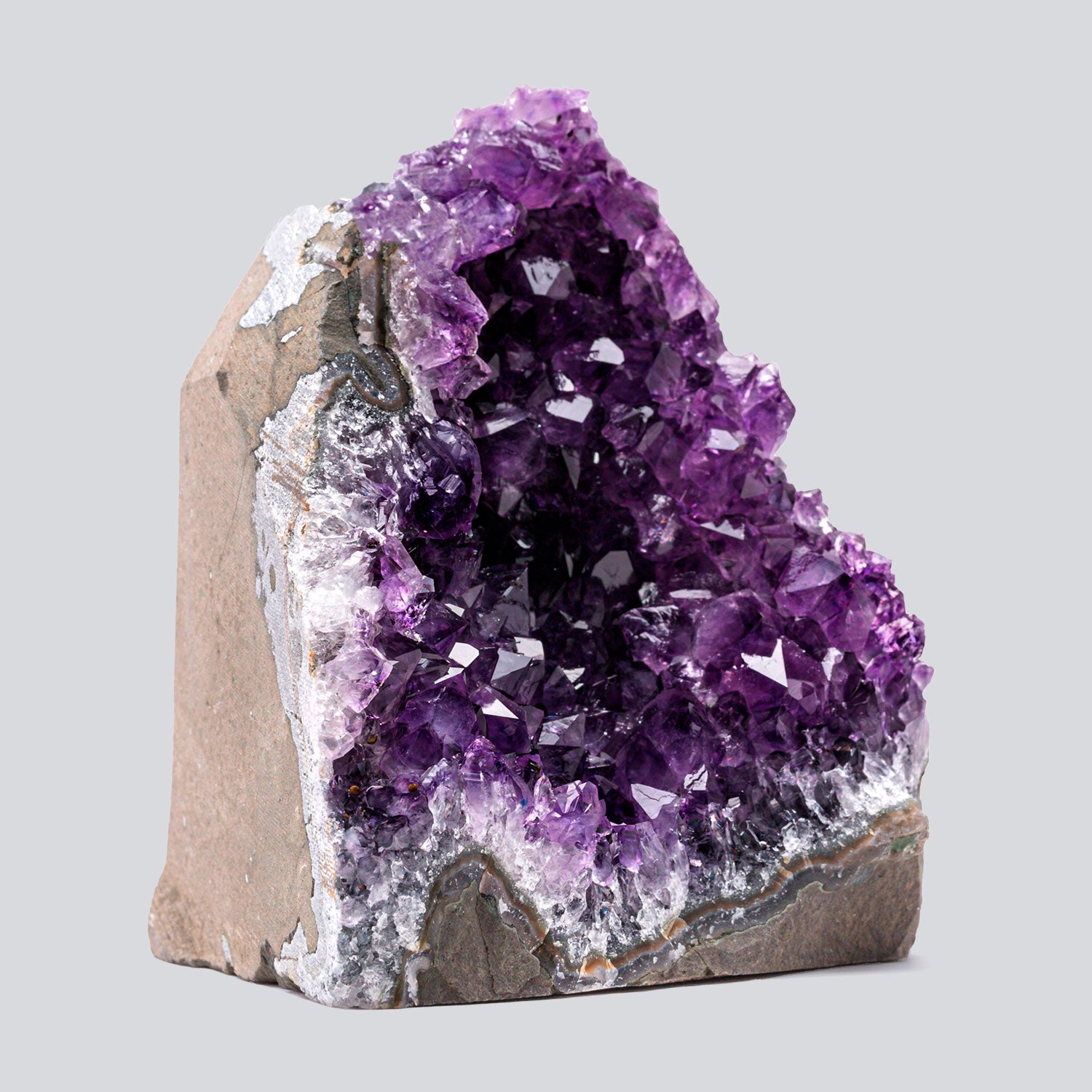
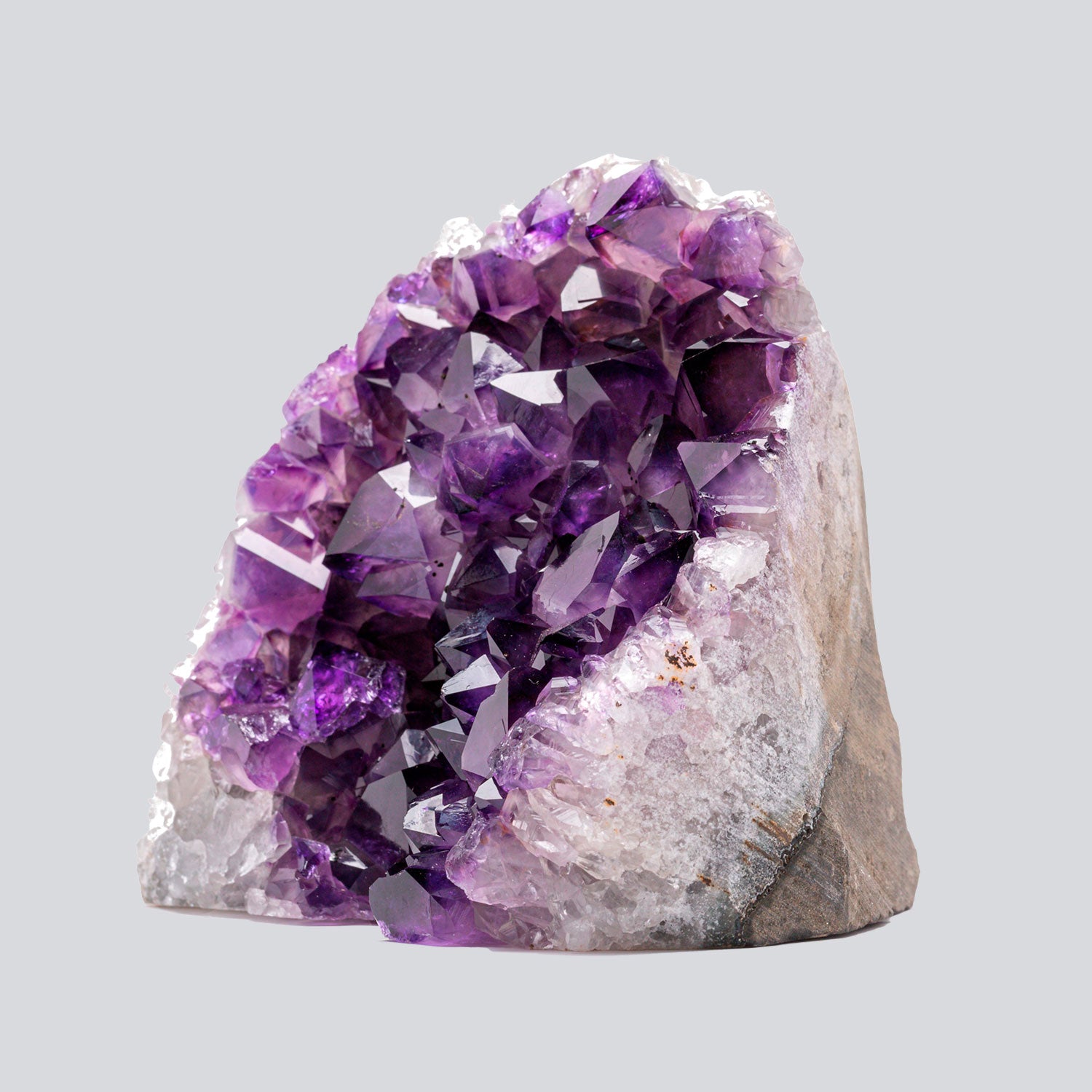
Amethyst geodes — the most prized variety. Deep violet crystals formed in volcanic basalt, primarily in Uruguay and Brazil. Uruguayan specimens are darker and more saturated due to the specific mineral composition of the Artigas region.
Quartz geodes — the most common. Clear to milky white crystals found worldwide. Beautiful in their simplicity, often the first geode many collectors encounter.
Calcite geodes — typically translucent with a softer, warmer glow. Found in sedimentary regions. Less dramatic than amethyst but quietly beautiful.
Agate geodes — characterized by banded patterns in warm tones of rust, cream, and brown. Popular in interior design for their earthy, graphic quality.
Cathedral geodes — the most monumental form. Large amethyst formations with multiple crystal peaks rising from a natural basalt base. Also called amethyst caves, these are statement pieces that anchor a room. Explore cathedral geodes.
What Makes Uruguayan Amethyst Geodes Different?
Not all amethyst is created equal. The distinction between Uruguayan and Brazilian amethyst — the two largest sources in the world — is significant and visible to the naked eye.
Brazilian amethyst tends toward lighter tones: pale lavender, soft violet, occasionally washed out. It is abundant and widely available. Uruguayan amethyst, particularly from the Artigas region in the country's northwest, is a different stone entirely. Its color is deeper, richer, and more saturated — a true deep violet that holds its intensity in any light.
This difference comes from geology. The basaltic lava flows of Artigas have a specific mineral composition and a formation history that produced unusually concentrated iron deposits within the quartz — the element responsible for amethyst's purple color. Millions of years of undisturbed crystallization in stable geological conditions allowed the color to develop fully.
At Emporion Gems, every piece is hand-selected at the source in Artigas. We look for depth of color, intact crystal formation, and a natural basalt base that grounds the piece without artificial alteration. No dyes, no treatments, no enhancements — just the stone as it formed.
Shop Uruguayan amethyst geodes
How to Display a Geode at Home
A geode is not a decorative object in the conventional sense — it is a geological specimen that happens to be extraordinarily beautiful. Displaying one well means giving it space to be itself.
Large cathedral geodes belong on the floor or a low shelf, where their full height is visible and their weight feels appropriate. They anchor a room the way a sculpture does — not decorating the space but defining it. Living rooms, entryways, and meditation spaces are natural homes for large specimens.
Smaller geodes and clusters work on desks, bookshelves, and nightstands. Placed near a window, they catch light differently throughout the day. Amethyst in particular shifts from deep violet in morning light to a warmer purple in the afternoon.
Geodes pair naturally with linen, wood, marble, and aged brass. Their organic geometry contrasts beautifully with clean architectural lines. They require no maintenance, no watering, no replacement — only occasional dusting with a soft dry cloth.
Choose the right geode size for your space
FAQ: Geode Questions Answered
Q: What is a geode rock?
A: A geode is a hollow rock with a crystal-lined interior, formed when minerals crystallize inside a cavity in volcanic or sedimentary rock over millions of years. Each geode is unique — the crystal type, color, and formation depend entirely on the minerals and geological conditions where it formed.
Q: How much is a geode worth?
A: Value ranges from a few dollars for small quartz geodes to several thousand for large Uruguayan amethyst cathedrals. Key factors are size, crystal color depth, formation quality, and origin. Uruguayan amethyst geodes hold their value better than most due to their rarity and superior color saturation.
Q: How do you know if a geode is real?
A: Real geodes have rough, uneven exteriors and uniformly crystallized interiors. They feel heavy for their size. Fakes are typically too symmetrical, may have dyed surfaces, or feel hollow. Purchasing from a verified natural source like Emporion Gems ensures every piece is 100% natural and untreated.
Q: What is inside a geode?
A: Crystals — most commonly amethyst, quartz, calcite, or agate. The interior color and crystal type depend on the minerals dissolved in the groundwater that filled the cavity over millions of years. Uruguayan amethyst geodes are known for their exceptionally deep purple interiors.
Q: Where do the best geodes come from?
A: For amethyst geodes, Uruguay's Artigas region produces the world's finest specimens — deeper in color and more saturated than Brazilian material. For agate geodes, Chihuahua in Mexico is a leading source. For quartz, deposits exist across the Americas, Africa, and Europe.
Every geode in the Emporion collection is a singular object — formed over millions of years, sourced with intention, and selected by hand. Explore the collection and find the one that belongs in your space.






Share: